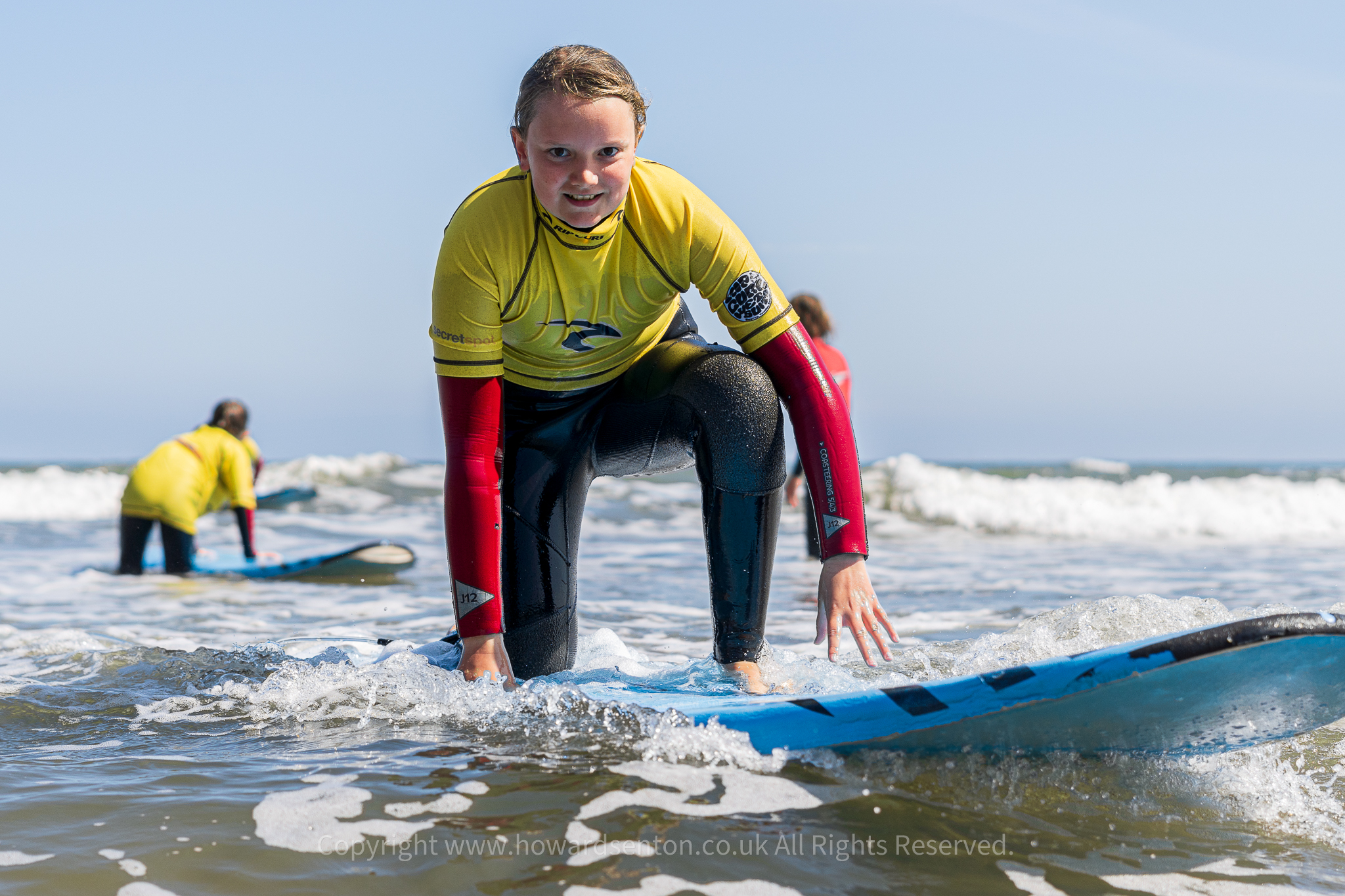
Starting to surf is exciting. There is nothing quite like catching your first wave, standing up on a surfboard and feeling the board glide under your feet.
But surfing has a steep learning curve, and beginners often make the same mistakes. The good news is that most of them are easy to fix.
Whether you’re learning to surf in Yorkshire, the North East or somewhere further afield, understanding these common mistakes can help you improve faster, stay safer and enjoy your time in the water.
1. Choosing the Wrong Surfboard
One of the biggest mistakes beginners make is trying to learn on a board that is too small.
Shortboards can look exciting, but they are considerably harder to paddle, balance on and catch waves with.
For most beginners, a larger, wider and more stable board is a much better choice.
A good beginner board should generally have:
- Plenty of volume
- Good width and stability
- A rounded or forgiving outline
- Enough length to make paddling easier
- A soft construction if you’re learning in a surf school environment
A beginner who catches lots of waves on a suitable board will usually progress faster than someone struggling on a board that is too advanced.
2. Starting in Waves That Are Too Big
It’s easy to watch experienced surfers and think, “I want to surf waves like that.”
However, bigger waves aren’t necessarily better for learning.
Beginners should start with small, manageable waves where they have enough time to paddle, stand up and control the board.
On the Yorkshire and North East coast, conditions can change quickly. A beach that looks small and friendly from the shore can become considerably more powerful as the tide and swell change.
If you’re unsure, ask a local surf school or experienced surfer for advice.
3. Not Learning Surf Etiquette
Surfing isn’t just about standing on a board. There are rules and etiquette designed to keep everyone safe.
One of the biggest beginner mistakes is paddling for a wave without checking whether another surfer already has priority.
Learn the basics of:
- Who has priority on a wave
- Where to paddle out
- How to avoid dropping in
- How to handle your board safely
- Where beginners should position themselves
- How to behave in a crowded lineup
Good surf etiquette will make you safer and more welcome in the water.
4. Trying to Stand Up Too Early
Many beginners see a wave coming and immediately start trying to stand.
Instead, you need to let the wave pick up the board first.
A good beginner take-off generally involves:
- Paddle strongly as the wave approaches.
- Keep your body positioned correctly on the board.
- Look forward rather than down.
- Feel the wave begin to lift and move the board.
- Push up quickly and smoothly.
- Land with your feet in a stable position.
- Bend your knees and keep your weight centred.
Trying to stand before the wave has properly picked you up often results in falling straight off the back of the board.
5. Looking Down at the Board
This is one of the most common mistakes.
When you stand up, it’s tempting to look at your feet.
Instead, look where you want the board to go.
Your head and upper body influence your balance and direction. Looking down can make you unstable and causes many beginners to lose the wave.
Keep your eyes up and look towards the open face of the wave.
6. Standing Too Upright
Another common mistake is standing completely straight.
Surfing requires a lower, more athletic stance.
Keep your:
- Knees bent
- Hips relaxed
- Weight centred
- Arms out for balance
Think of your stance as being similar to an athletic position rather than standing normally on the beach.
7. Having the Wrong Foot Position
Your feet need to be in the right part of the board.
Beginners often stand too far forward or too far back.
If you’re too far forward, the nose can dig into the water. Too far back and the board can slow down or become difficult to control.
Your instructor can help you find the correct position for your particular board.
8. Paddling With Poor Technique
Paddling is a huge part of surfing.
You can spend more time paddling than actually standing up, particularly when learning.
Common mistakes include:
- Lying too far forward
- Lying too far back
- Keeping your elbows too wide
- Taking weak strokes
- Not looking where you’re going
- Paddling with poor timing
Your body should be positioned so the board sits naturally on the water rather than the nose constantly pointing upwards or digging under.
Good paddling technique will help you catch more waves.
9. Not Practising the Pop-Up
Your pop-up is one of the most important movements in surfing.
You don’t want to be learning it for the first time when you’re already being pushed down a wave.
Practise your pop-up on the beach or at home.
A good practice routine is to lie on the floor as though you’re paddling and repeatedly practise moving quickly into your surf stance.
The aim is to make the movement quick, controlled and automatic.
10. Forgetting About the Leash
Your leash is an important piece of safety equipment, but it doesn’t mean you can simply let go of your board.
A surfboard can be dangerous if it hits another surfer.
Always keep control of your board where possible and understand how your leash works.
Check that:
- The leash is attached securely to the board.
- The ankle cuff is fitted correctly.
- The leash isn’t twisted unnecessarily.
- The leash is appropriate for your board and conditions.
Never wrap the leash around your hand.
11. Holding the Board Incorrectly in the Surf
Getting out through the waves can be difficult when you’re learning.
Beginners sometimes hold the board incorrectly and get knocked backwards by whitewater.
Learn how to position yourself and your board when dealing with breaking waves.
With smaller beginner boards, you may be able to push the board through smaller waves. Larger boards require different techniques.
Your surf instructor can show you the safest method for your equipment and the conditions.
12. Spending Too Much Time Sitting in the Wrong Place
Beginners often paddle straight out and sit wherever they find themselves.
Positioning is important.
You need to understand:
- Where waves are breaking
- Where other surfers are sitting
- Where you can safely catch smaller waves
- Where you can paddle back out
- Where you can safely get back to the beach
Good positioning can dramatically increase the number of waves you catch.
13. Trying to Catch Every Wave
You don’t need to catch everything that comes towards you.
Learning to read waves is just as important as learning to stand.
Watch the waves before paddling for them.
Look at:
- Where they are breaking
- Their direction
- Their size
- How quickly they are moving
- Whether another surfer has priority
Sometimes the best decision is simply to let a wave pass.
14. Not Checking the Conditions
Never assume that yesterday’s conditions will be the same today.
Surfing conditions can change because of:
- Swell direction
- Swell size
- Wave period
- Wind direction
- Tide
- Local beach shape
- Weather
This is particularly important around the Yorkshire and North East coast.
Before heading into the water, check a reliable surf forecast and look at the beach yourself.
15. Ignoring the Tide
The tide can completely change how a beach works.
A beach might produce gentle waves at one stage of the tide and much more powerful waves later.
Different beaches also respond differently to rising and falling tides.
If you’re learning, ask experienced local surfers or instructors which part of the tide normally provides the most suitable conditions.
16. Surfing Alone When You’re Still Learning
Surfing with other people can make learning more enjoyable and safer.
If you’re inexperienced, consider taking lessons from a reputable surf school.
An instructor can teach you things that are difficult to learn by yourself, including:
- Safe positioning
- Surf etiquette
- Board handling
- Paddling
- Pop-ups
- Wave selection
- Beach safety
A few lessons can save you a lot of frustration.
17. Trying to Progress Too Quickly
Surfing can be frustrating because improvement isn’t always linear.
You might have an amazing session one day and struggle the next.
Don’t worry.
Progress can come from simply:
- Catching more waves
- Paddling better
- Improving your pop-up
- Staying balanced longer
- Learning to read waves
- Understanding positioning
Focus on small improvements rather than trying to master everything at once.
18. Not Respecting Other Surfers
Surfing is a shared experience.
Crowded beaches require patience and awareness.
Don’t paddle directly through someone’s wave, drop in on another surfer or deliberately position yourself somewhere that creates danger.
A friendly attitude goes a long way.
Remember that everyone was a beginner once.
19. Not Looking After Your Equipment
Saltwater, sand and sun can be hard on surf equipment.
After your session:
- Rinse your board with fresh water when possible.
- Rinse your leash.
- Allow equipment to dry properly.
- Keep your wetsuit out of direct heat.
- Check your board for damage.
- Check your leash regularly.
Looking after your equipment can help it last much longer.
20. Forgetting to Enjoy Yourself
Perhaps the biggest beginner mistake is becoming too focused on getting everything perfect.
Surfing is supposed to be fun.
You will fall.
You will miss waves.
You will sometimes stand up and immediately fall off.
That’s all part of learning.
Every experienced surfer has been through it.
Final Thoughts
Learning to surf takes time, but avoiding the most common beginner mistakes can make the process much easier.
Choose the right board, start in suitable conditions, learn surf etiquette, practise your pop-up and spend time learning how waves work.
Most importantly, respect the ocean and enjoy the process.
If you’re learning to surf around Yorkshire or the North East, conditions can be challenging but incredibly rewarding. Take your time, listen to local advice and don’t be afraid to spend a session simply watching the waves.
The more you understand the ocean, the more enjoyable surfing becomes.
No responses yet